

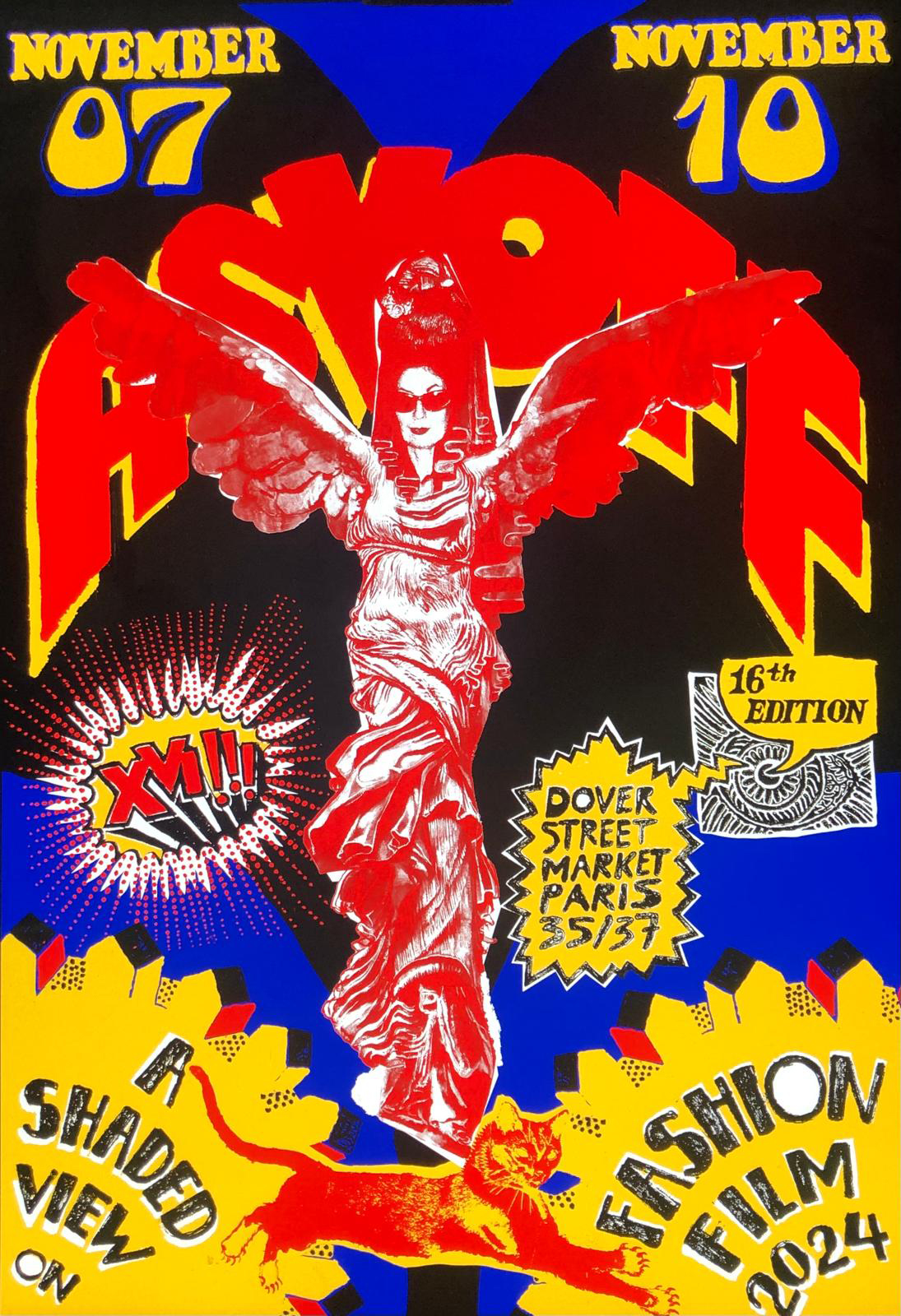
The 16th edition of ASVOFF will take place from November 7 to November 10 at the Dover Street Market in Paris, 35/37 Rue des Francs Bourgeois. Over four days more than 130 films will be screened at ASVOFF – A Shaded View on Fashion Film, the world’s first film festival dedicated to fashion, style and beauty. Emerging filmmakers and legendary directors from across the globe are evaluated by a jury of fashion, film, and design luminaries who select finalists for best-in-category recognition.
Today, we’re joined by Pedro Guez, a passionate creator and visionary whose work is shaping the future of fashion filmmaking through the lens of artificial intelligence. As co-founder of the AI-Generated Film category at ASVOFF, alongside the incomparable Diane Pernet,

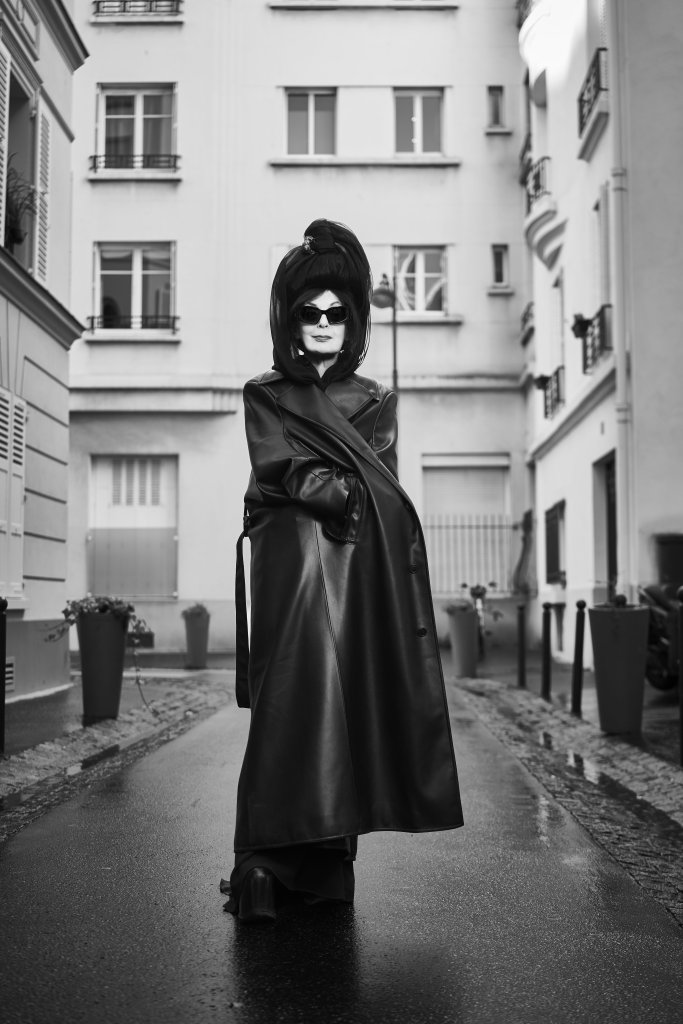
Pedro has been at the forefront of integrating AI into the world of fashion film. But for him, AI is more than just a tool—it’s a true creative partner, one that opens up new possibilities, transforms narratives, and helps creators push beyond traditional boundaries. Pedro’s journey has always been rooted in his love for storytelling and film. With a background in fashion filmmaking and a deep commitment to education, he’s spent years inspiring students and professionals to explore the intersection of creativity and technology. His current studies at IFM in Paris have only deepened his understanding of how digital innovation is transforming industries like fashion, design, and filmmaking. For Pedro, AI isn’t just about the technology; it’s about the vision behind it, the story you want to tell, and how it can bring people together through shared creative expression.
As head of the jury for the AI category at ASVOFF, Pedro is helping shape a new wave of filmmaking where technology and humanity exist in harmony. In this conversation, we’ll hear about his thoughts on the evolving role of AI in fashion, how it’s transforming storytelling, and the ethical responsibilities creatives face when using this powerful tool. We’ll also get a glimpse into his excitement for the future—how AI can help us rethink everything from sustainability to inclusivity in fashion and filmmaking:
In 2023, together with Diane Pernet, you introduced the AI-Generated Film category at ASVOFF, can you share a bit about your background and what initially sparked your interest in the intersection of artificial intelligence and fashion filmmaking?
For me, Artificial Intelligence is more than a digital tool, it’s a true partner in creativity. It enables me to recreate ideas and transform them into audiovisual concepts that not only excite me but also highlight the immense creative potential and vision of the human mind behind today’s ever-evolving digital technologies. As a creative, AI has allowed me to craft unique atmospheres and visuals that enrich my narratives, inviting me to rethink and reshape ideas throughout the creative process. This allows for projects like mine to be explored and reinvented by countless creators around the world every day. Film has always been one of my passions.
A few years ago, I coordinated and taught fashion film workshops for students with diverse professional backgrounds. Just as it did for them, AI now allows professionals and enthusiasts alike to bring to life images and narratives that surpass their physical or financial resources. AI not only democratizes film production but also opens up new creative dimensions and enriches the global artistic conversation. What truly matters is the creator’s purpose and the story they want to tell, with or without AI. This tool is simply a means, but the message, purpose, and human connection behind each work are the real forces that inspire and drive it forward.

Can you elaborate on your vision for the role of AI in reshaping the fashion industry? How do you foresee AI impacting design processes, visual merchandising, consumer engagement, and sustainability within the next few years?
A few months ago, my vision for AI in fashion was fully digital, with goals centered in fictional realms, whether in the metaverse, video games, audiovisual creations, or even social media. Today, as an EMBA student at IFM in Paris, I’ve had the chance to see how CEOs, key players in the industry, students and newcomers in this field make use of digital technologies and share their opinions on them. I’ve noticed certain patterns emerging, such as environmental consciousness, inclusivity in every sense, the joy of imaginative creation, and above all, the realization that this tool can bring to life exactly what they envision. Inspiration should live in all of us, guiding how we spend our time and approach our work, no matter the field.
In my work, I find joy in creating hybrids that blend AI with now-classic elements, just like photographs, hand-drawn sketches, videos, or 3D renderings. I believe that by embracing a “Frankenstein” approach, where we integrate a wide array of creative resources, we can infuse each creation with a deeply personal essence and development. AI is not just a tool, it’s a call for a collective ethical awareness in how we create and connect.
As AI evolves, providing new insights into consumer behavior, enabling unique experiences, inspiring artworks, and offering academic contributions, we too, as humans, need to evolve. After all, we are the ones who set the direction. The future rests in our hands, memories, and innovative ideas, and as we advance technologically, it is our vision, intention, and creativity that will shape the world ahead.
Could you introduce to us the jury members from the AI category of this year’s ASVOFF? Can you explain the process for selecting jury members in the AI category? What qualities or backgrounds do you look for in jurors to ensure a diverse and knowledgeable panel?
I have deep admiration for every member of our AI jury this year. The gift of creation and passion is something they all share, and I really respect the paths they’ve each taken. What excites me most is the potential for co-creation and the exchange of ideas that can emerge when two or more passionate minds come together. Creativity is one of the things I value most in life, and when it’s artistic, it becomes even more powerful.
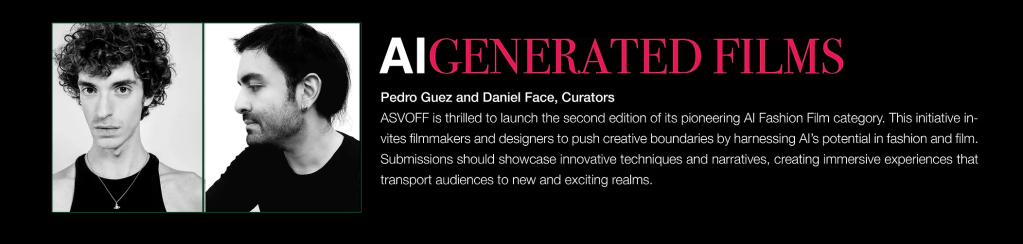
This is the second edition of the AI-Generated Film category at ASVOFF, and I’m glad that Daniel Face, Editorial Director of Red-Eye World, has joined us this year. Working closely, we curated the submissions we received.
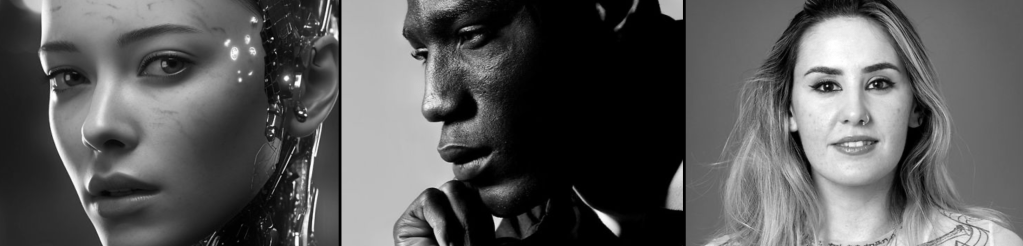
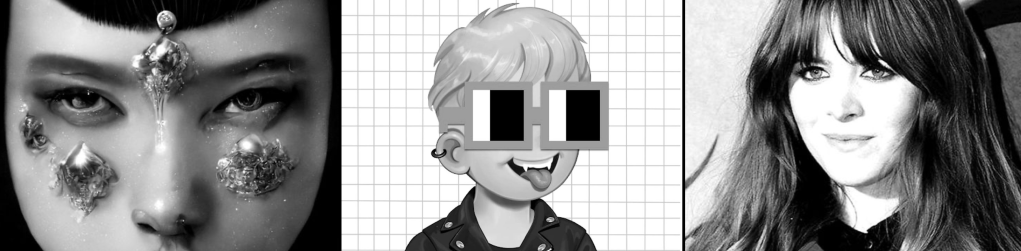
One thing that makes this category unique is that Artificial Intelligence is not only a theme but also serves as a juror in its own category, offering a great blend of technology and artistic vision. Alongside AI, our jury includes: Tafari Hinds, Digital Editor at Red-Eye; Dr. Giovanna Graziosi Casimiro, XR Specialist and Brand Strategist; Matthieu Grambert, Augmented Generative Art Director and Artist; Sebastian Felix Topescu, Fashion Stylist, Editor, and TV Host; Omar Karim, AI Creative Director and Image Maker; Anna Dart, Multidisciplinary Artist; Stella Achenbach, Metaverse Designer and Founder of The Alana Project; Clare Maguire and Leo Crane, AI Film Academy Co-Founders; and Leonel Piccardo, Digital Fashion Artist.


This year’s edition is also supported by Red-Eye and the AI Film Academy, and I am incredibly grateful for the strong support we’ve received from our community on social media. It has truly fortified the AI category of the festival, creating a global and inclusive space that is both innovative and relevant to today’s digital world. When selecting jury members, my goal is to ensure diversity in both expertise and perspective. We look for individuals who bring a wealth of knowledge from different corners of the creative, technological, and fashion worlds. The variety of backgrounds creates a dynamic panel that can offer a well-rounded view of the submissions. It’s not just about technical skill but about the passion, vision, and cultural awareness each juror contributes.
With AI’s growing influence, what ethical dilemmas do you believe filmmakers face when representing diverse identities and cultures? How can filmmakers navigate these challenges responsibly?
I had the opportunity to see a short film created by a group of students, who set out to rethink a makeup brand commercial they saw on social media. The original ad claimed to offer a product “for all skin types,” which was false. These students used AI to develop a short film with the goal of fostering true inclusion. While their work did a great job representing a wider diversity of skin tones, they still needed to refine their sense of inclusivity. The film was missing certain body types, genders, and other aspects of diversity. As a first attempt at using AI in their school project, I applaud their effort, but it’s also clear that AI removes many of the excuses for not achieving a fully inclusive representation. If we want to create something, we can now do so.
Language is culture, and much of the work today in AI creation is rooted in text. Prompts. The responsibility and objectivity of creators lie in their own knowledge and awareness. AI cannot truly represent what it doesn’t understand, and that’s where the human mind and intention come into play. The most important factor is always the creator’s purpose and how they choose to use this tool. It’s not just about technology, it’s about how we, as creators, channel our understanding, values, and vision into it.
Filmmakers and creatives today must take this responsibility seriously, ensuring that they represent diverse identities and cultures in a way that respects their layers. Ethical dilemmas occur when we fail to recognize the complexities of different cultures or when representation is used superficially. Navigating these challenges means being conscious of the histories, values, and stories we’re telling, and remaining humble in our approach. We must prioritize authenticity, learning from the communities we aim to represent, and reflecting on our role in the narrative.
AI is an incredible tool, but it cannot replace the deep, empathetic understanding needed to do justice to the identities we seek to portray. Our job is to remain vigilant, continuously educate ourselves, and use AI responsibly, ensuring that the stories we tell honor the richness of life’s diversity while embracing our collective duty to shape a more inclusive world.
In your experience, how does AI challenge or enhance the creative process in fashion filmmaking? Could you share an example where AI contributed to a unique artistic direction or storytelling approach?
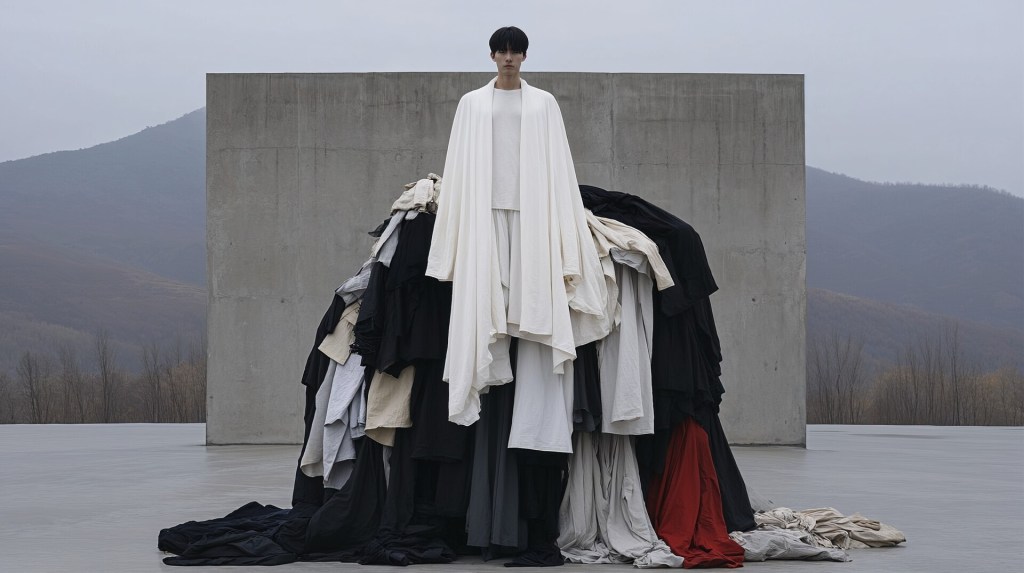
Last year’s winner in the AI-Generated Films category at ASVOFF used AI as one of several elements in creating their film. It was a hybrid of human models, garments with AI-generated alterations, futuristic environments, and visual narratives that received positive feedback from the entire jury. The film’s uniqueness lay in how the creator merged traditional and digital elements, creating a world that was both familiar and fantastical. AI enhances the creative process by offering new dimensions, textures, and perspectives that weren’t possible before.
However, to create a great film, it’s essential to have a clear idea of the message and narrative you want to convey to the viewer. When using AI, you’re dealing with a tool that can be capricious, generating an infinite number of possibilities, and if not carefully guided, it can distort or alter the original idea. If the goal is to explore creativity and bring something new, AI can help. But if it’s just about showing off the tool without a clear vision, the result can feel disjointed and lack a meaningful story. In these cases, the project risks losing its impact, focusing more on the tool than the story.
As this is the second edition featuring an AI category at ASVOFF, what are your impressions of its evolution since last year? Have you noticed any significant changes in the types of submissions or the way filmmakers are approaching AI in their projects?
There has been a great increase in attention to detail this year, particularly in elements such as sound design, character movements and gestures, as well as a more consistent flow between scenes and transitions. The submissions this year reflect a technological advancement, which was a sentiment shared by most of our jury members. It’s exciting to witness how creators are becoming more adept at incorporating AI into their storytelling.
Something interesting is that AI is no longer just a tool for visual creation, as it’s now becoming a fundamental part of narrative architecture. Filmmakers and creatives are integrating AI into their projects in more sophisticated ways, using it not just to create cool visuals but to enrich the emotional and thematic depth of their stories. The technology is evolving, and so are the minds behind these projects. This is just the beginning, and the potential for innovation, community building, and creative exploration is limitless. I believe that AI, when used responsibly and imaginatively, will continue to rethink the industry and inspire a new generation of filmmakers and storytellers.
There’s a fine line between fully counting on AI’s prowess and using it as a tool, what would be our advice for future submissions in navigating this and can you provide an example of a film that exemplifies this balance?
Our advice for future submissions would be to view AI as a resource to amplify creativity rather than a replacement for it. While AI offers new perspectives and can simplify processes, the human touch remains essential for capturing emotion, narrative, and cultural context. It is this unique human element that allows creativity to resonate deeply with audiences, transforming a digital creation into something meaningful.
This year, we received “Behind the Seams”, a documentary by Gianluca Traina about the impact of clothing consumption on the planet, which was entirely created with AI. It’s an example of how AI can serve as a powerful creative tool while also addressing pressing global issues through storytelling.
We should consider AI as a means to strengthen the work, but never lose sight of the human intention and artistic vision behind it. As I said, AI is a true partner in creativity, but it should always serve the creator’s voice, not overshadow it.
Looking ahead, what excites you most about the future of AI in fashion filmmaking, both as a jury head and as someone passionate about the industry? Is there a particular project or concept you hope to see more of in the coming years?
While many submissions tend to lean toward science fiction, futuristic themes, or even horror, there is so much more to explore. Personally, I find immense joy in watching films with monstrous characters or out-of-this-world atmospheres, as they open up new dimensions of imagination. But there are countless untapped cinematic horizons. One concept I’d love to see is the blending of AI with human-centered, emotionally rich storytelling, something like an Almodóvar-style film created with AI. Imagine the depth of human emotion, narrative complexity, and cultural richness that AI could bring to such a film. The creative possibilities are endless. The future of AI in creative fields lies in this symbiotic relationship between technology and the human spirit.
As we conclude, is there any final message or insight you’d like to share with filmmakers who are exploring the intersection of AI and fashion? What should they keep in mind as they push the boundaries of creativity in their work?
The chance to discuss and choose whether or not to incorporate AI into one’s artistic or professional work is a tremendous privilege. We live in a time of political, economic, and planetary chaos, yet we have the freedom and opportunity to explore new creative horizons. Curiosity is an essential part of life, and AI can serve as a powerful tool for exploration and even self-exploration.
I’ve noticed that many AI artists are creating incredible works but often only share them within their personal social media circles, as they tend to be shy or self-critical when using the latest technology. I encourage all of them to submit their creations to ASVOFF. One of our goals is to celebrate fashion, culture, and film, and I believe that by sharing their work on this platform, they can inspire others, spark conversations, and contribute to the growing community of AI-driven creativity. The intersection of AI and fashion filmmaking is still in its infancy, and we’re only beginning to unlock its full potential. So, I urge everyone to be part of history.
As we wrap up this insightful conversation with Pedro, one thing is clear: the future of fashion filmmaking is limitless. With AI as a partner in the creative process, the potential to reshape how we tell stories, connect with audiences, and challenge the status quo is more exciting than ever. Pedro’s perspective reminds us that technology is not just about innovation for the sake of it—it’s about using new tools to amplify human creativity, authenticity, and purpose.
Since its launch in 2008, ASVOFF has gained critical acclaim for encouraging both emerging and established artists to reconsider the way that fashion is presented and for challenging the conventional parameters of film. ASVOFF tours the globe with screenings at prestigious institutions and events like the Centre Pompidou, the Guggenheim, the Barbican, Art Basel Miami, CaixaForum Barcelona, the Franz Mayer Museum and the Cannes Film Festival in a host of creative capitals such as New York, London, Tokyo, Milan, Moscow, Mexico City. ASVOFF is not only a competition of short fashion, style and beauty films but also a travelling international event showcasing feature films, documentaries, conferences, performances and installations – making it a must-see on both the fashion calendar and the film circuit for its genre-bending and groundbreaking programme.
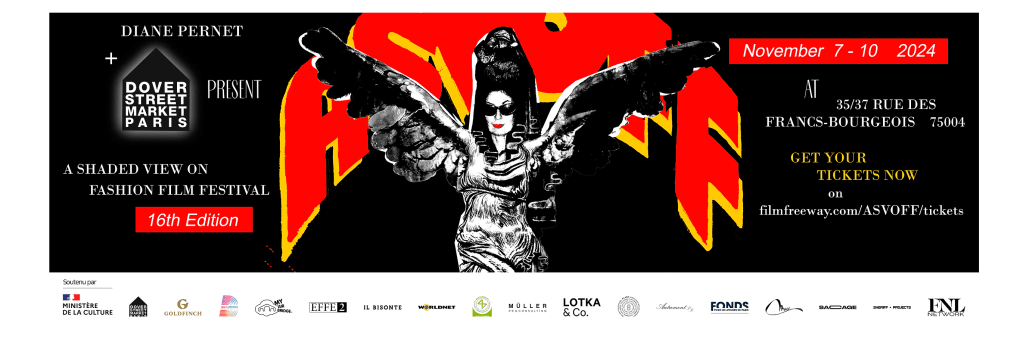
ASVOFF 16 Poster _ Illustration by Miguel Villalobos
ASVOFF x WORLDNET
Directed by Miguel Villalobos
ILLUSTRATIONS AND ART DIRECTION BY MIGUEL VILLALOBOS
EDITING ANIMATION BY JEN CAMPBELL
SOUND DESIGN AND MUSIC BY ANDY DAZE
Website: https://www.ashadedviewonfashionfilm.com
Words + interview by
 33 MAGAZINE