


GOTBIGMILK is built on the exploration of the masculinization of the meat industry, objectification of women, animal products and the absurdist of its marketing.
I was initially intrigued by Superbowl style burger ads and the iconic “got milk?” campaigns. This led me down a rabbit hole to find that there is a slew of surprisingly overtly sexual and sexist campaigns related to the meat industry throughout history. Using sex to sell meat based products was not a new concept and it wasn’t getting old anytime soon. I asked myself, why is meat so masculinized and why do we as a society so heavily associate women’s bodies to meat based food products? Where does this thought that meat must be provided by women along with a smile on her face and sex readily available. Why has the media decided this is the ideal way to sell meat and why has it been working so well, for so long?


It’s impossible to ignore the very obvious impact the western world and colonization has had on the creation of this phenomenon. Paintings of white, European kings with large hunks of meat and their queens with small bushels of fruit, enslaved people only having access to undesired leftovers of meat (pigs feet, ears, intestines, etc). In history, you see “elites” had access to meat, dairy, bread, whilst the poor only had access to fruits, vegetables and starchy foods they could grow (barley, oats, corn, potatoes, carrots, etc). Grown foods also indicated class, foods grown from the ground often were not deemed as suitable for people of higher class and status, foods that were elevated and in trees were preferred.
Columbus’ second voyage brought “proper” meat (cows, pigs, sheep, goats, horses) to Latin America, this colonization brought the idea of domesticated animal exploitation. Native Latin American meats and meat based resources (typically wild game) were deemed second class resources. In primarily native areas and cultures, eating habits were seen as “savage” and lower class because of their predominantly vegetable and wild game based diets. This culture transformed and grew like a tumor just as the attitude that people who are not men or white are lower class than those who are.

The association of plant based diets with weakness and inadequacy has shown up in all stages of history in large and small ways. Domestic violence rates rose in conjunction with a meat boycott protesting the rising meat prices in 1973, countless women suffered because they didn’t serve their husbands meat for dinner. In the first national food survey of British diets in 1873 the main difference between men and women of the same family was the amount of meat consumed. When conscious distributions of meat were forced by poverty, women and children ate meat once a week whilst men ate meat almost daily.
In a world of abundance we see these gender and race based food politics less but they are still intertwined within our society, often showing up in our diets and advertising. Food deserts are still plaguing primarily indigenous, black and impoverished communities. Low quality meat based fast food restaurants dominate lower income areas rather than grocery stores with nutritious alternatives. Quick, low cost, ready made meals are primarily meat and starch based rather than fruit and vegetable based which is in line with the “cheaper food paradigm”. Meat advertisements are still overtly sexual and masculinized (Super Bowl burger ads, Burger King “blowjob”, Slim Jim “party with the meat stick”, Carls jr “she’ll tell you size doesn’t matter” Fairlife “milk with flair, drink what she’s wearing” an entire “got milk?” campaign).

Seeing the sheer variety of overtly sexual and sexist advertisements for meat based products, statistics on the “cheaper food paradigm”, soaring cattle counts and animal exploitation to match i started to think, what exact environmental impact is the meat industry having on us. According to the United Nations Environmental Program, our global food system is the primary driver of biodiversity loss, with agriculture alone being the identified threat to 24,000 of the 28,000 species at risk of extinction. Our land is suffering, our people are suffering and our native species are suffering. Yet the use of agricultural land, cattle count, related exports and estimated value of our meat and dairy industry are barely affected.
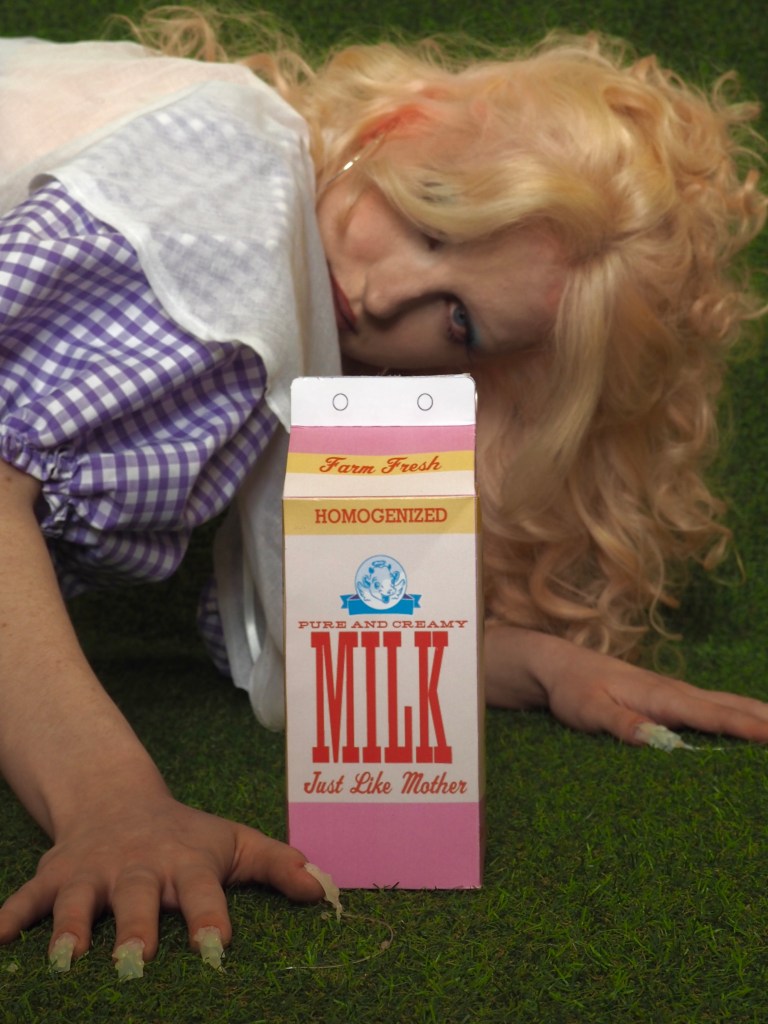
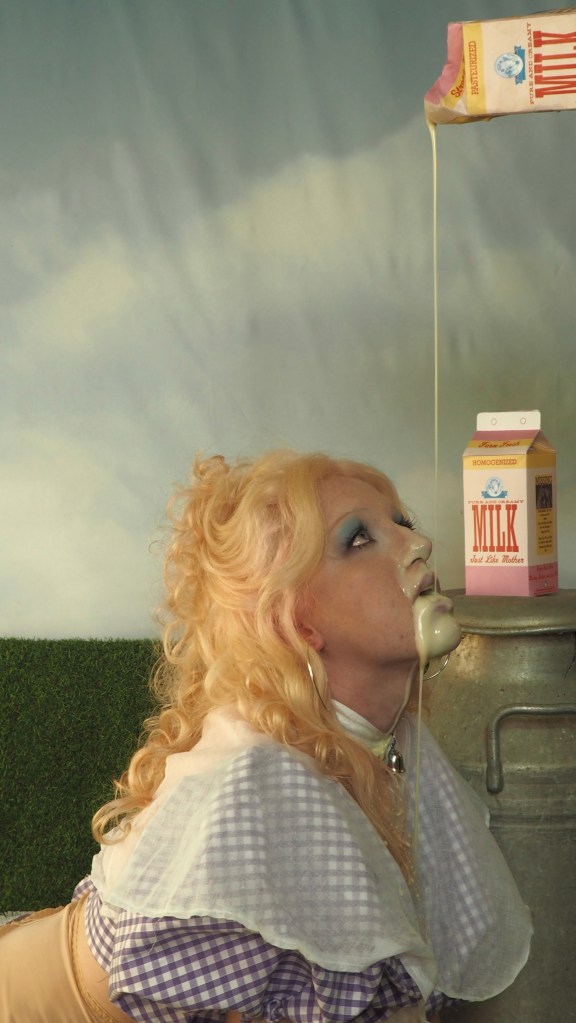
We used actual marketing lines from old milk bottles and ads to create our milk cartons, mimicking these absurd advertisements and incorporating our own implication that our milk is coming from women like our model. We wanted to portray our model as an “ideal” woman through a multitude of eras. We used traditional silhouettes of a 1960s housewife with a modern blonde bombshell twist. Bullet bra, puffed up bloomers, big sleeves and a collared capelet with a modern tartan string bikini under sheer bloomers, a high wasted girdle used as an accessory rather than shape wear, large statement hoops, thigh highs and little kitten heels. Our set was intentionally very plastic, empty and two dimensional, we wanted to emphasize the unnatural aspects of these advertisements and industry, creating feelings of empty space and intimacy between model and viewer.


Our model smoothes milk into grass, chugs milk while it runs down her front, dripping off her bullet bra, licks milk off her hands and the floor all while gazing directly into the camera, something we know all too well from these sexualized food ads, but somehow this time it doesn’t feel seductive. GOTBIGMILK is absurd and almost camp, our model dares you to fetishize her body and actions, the camerawork as still and fixed as her gaze, it’s intimidating. A head on confrontation with our own desire and hypersexualization of women, meat and the categorization of the two.
by Juno Hartigan + Katie Abdullah
CREDITS:
Creative Direction: Juno Hartigan + Katie Abdullah
Outfit Design + Creation: all pieces handmade – Juno Hartigan + Katie Abdullah
Milk Carton Design + Construction: Juno Hartigan + Katie Abdullah
Set Design: Juno Hartigan + Katie Abdullah
Photography + Editing: Juno Hartigan | Film Photography: Jodie Galvin
Advertising Video: Leo Tuan | Backstage + Camera Assistance: Leo Tuan
Model: Charlotte Angel


 33 MAGAZINE