

Words + Interview by Eleonora Pili
Unveiling DZHUS: Irina Dzhus on Fashion, Sustainability, and the Utopia of Self-Discovery
DZHUS is a Ukrainian conceptual brand founded by designer Irina Dzhus in 2010, international recognized for its multi-purpose, cruelty-free garments. The brand focuses on sustainable fashion, promoting versatile wardrobes that minimize shopping. Since the war began, DZHUS has relocated to the EU, donating 30% of its profits to Ukrainian animal rights organizations.
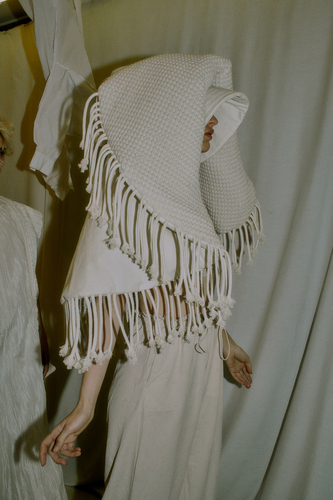
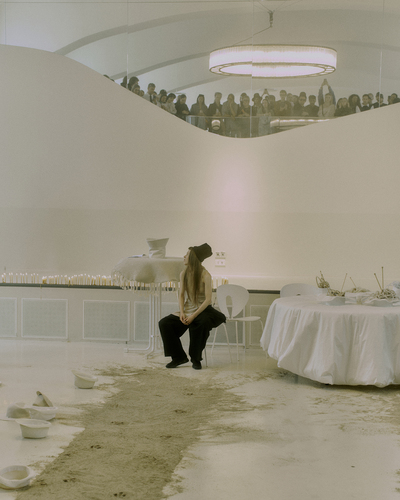
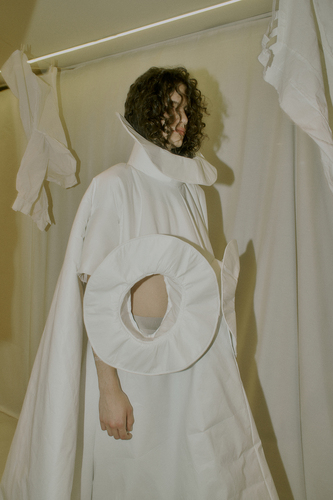
Images by WANG DAHOW at Berlin Fashion Week
A vegetarian-friendly brand using only ethical materials, DZHUS won the Cruelty-free Fashion prize in 2019 and has been featured in top international press, with collections presented at major global fashion events. Known for challenging gender norms, DZHUS promotes eco-conscious design and aims to popularize ethical fashion through innovative, intellectual allegories.
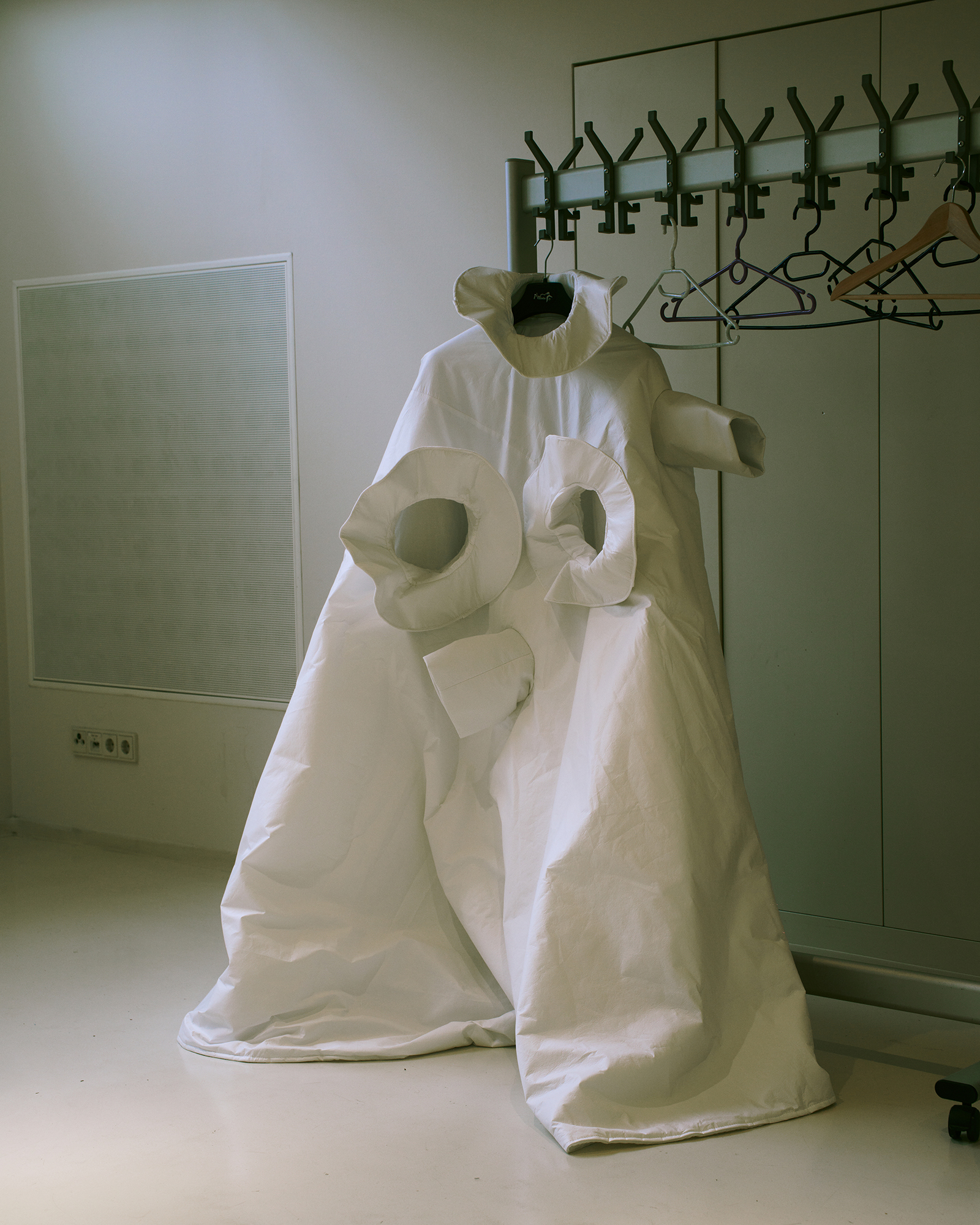
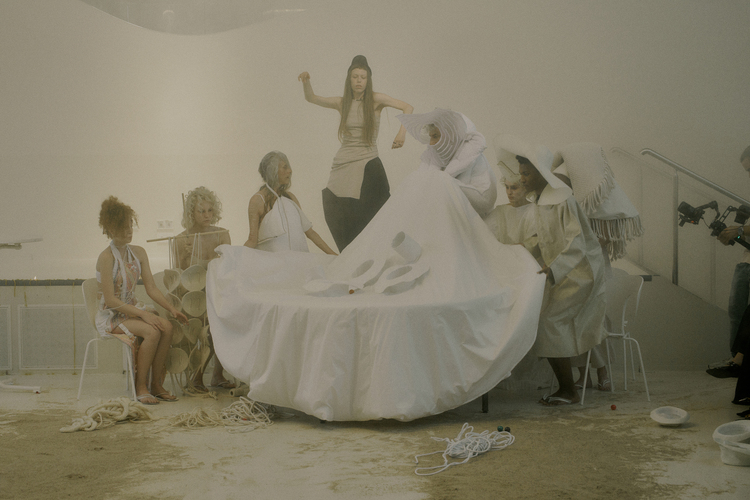
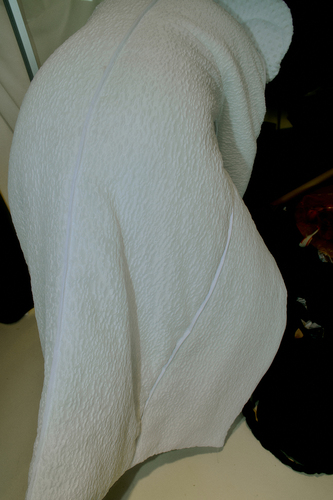
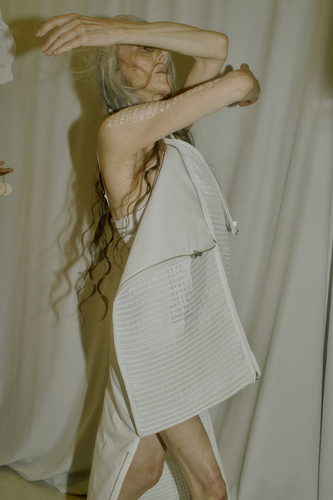
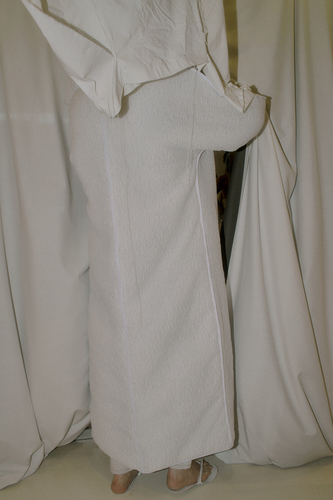
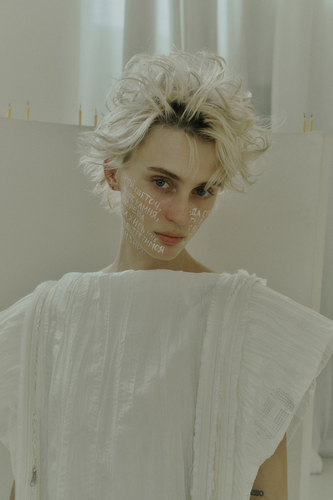
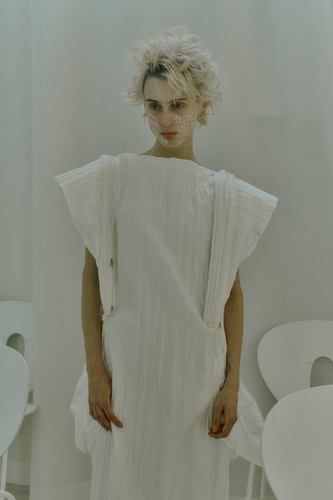
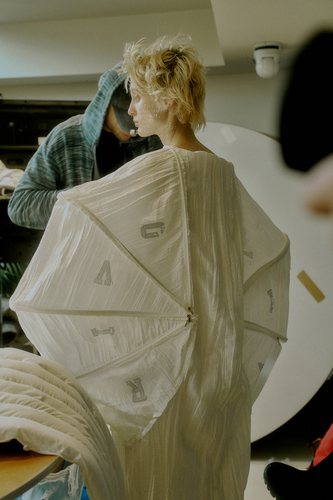
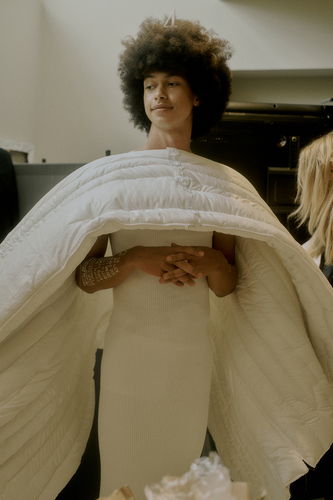
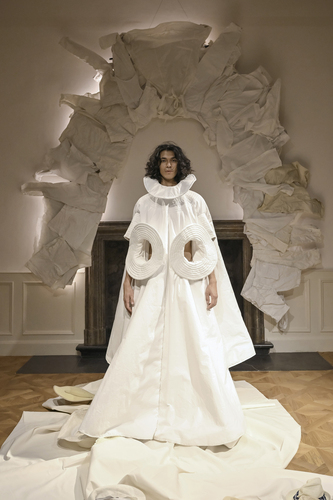
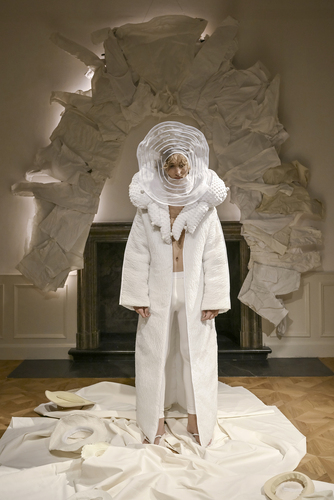
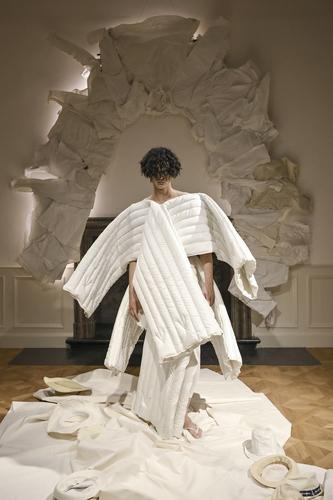
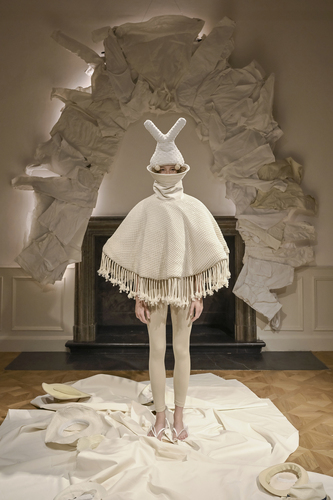
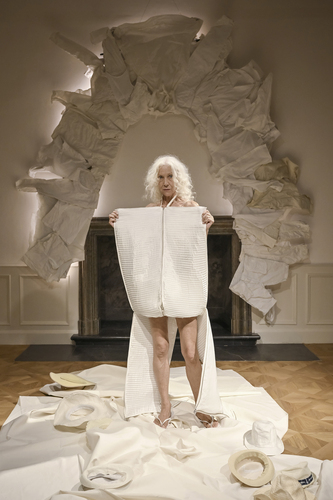
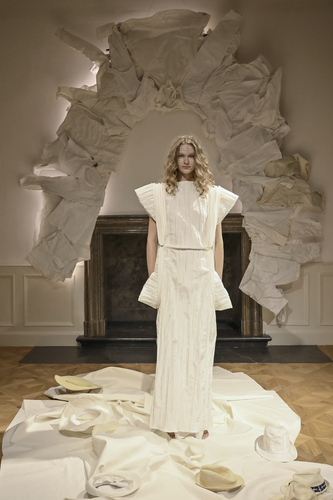
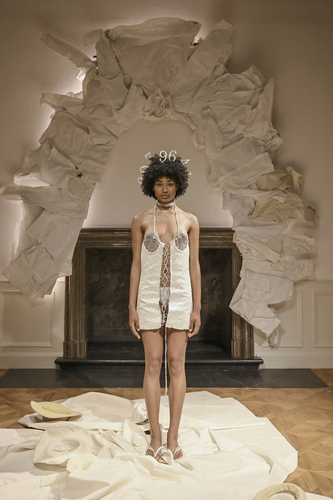
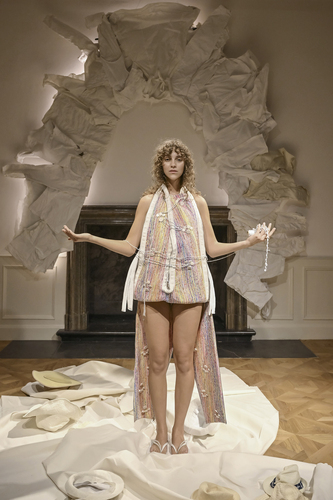
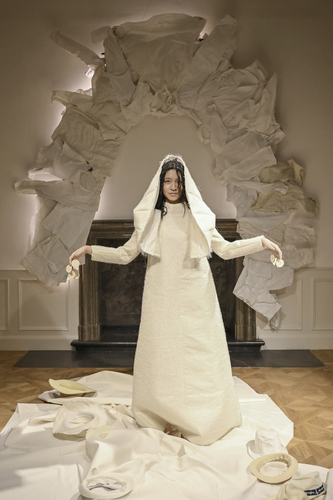
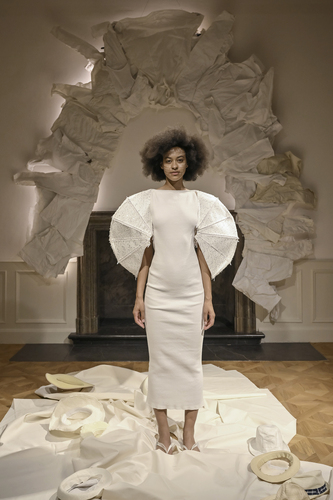
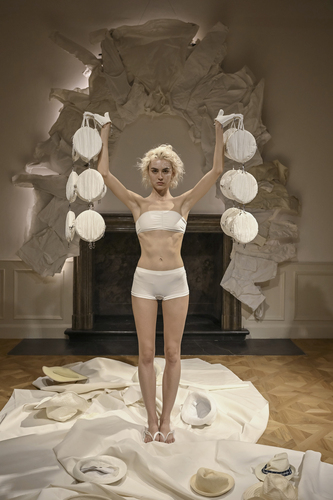
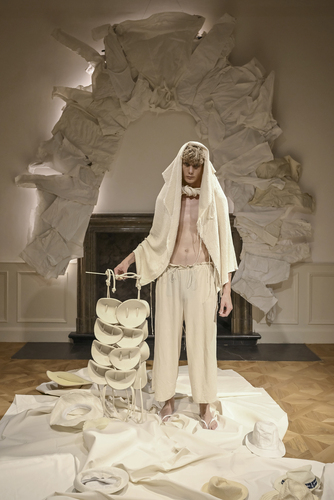
The Spring-Summer 2025 collection, in particular, explores the ‘Utopia codes’ humanity creates in the pursuit of happiness, as Irina Dzhus reflects on personal trauma and sociocultural conformism. The collection poses the question of whether finding “where you belong” can replace the essential feeling of home. Drawing inspiration from ritual table settings and autophagia, the designs blend spirituality, consumerism, and self-sufficiency, with multifunctional clothing that embodies stoicism. DZHUS further challenges gender stereotypes and incorporates metaphysical elements, like rainbow gradients hidden under white garments, symbolizing life and fulfillment. Alongside these themes, the collection features references to animal compassion and the fluidity of social roles, with deconstructed homeware objects, such as a tablecloth that transforms into a cape.
Images by WANG DAHOW at Berlin Fashion Week
Irina, how has your personal journey shaped the vision and philosophy of the DZHUS brand?
For the past three seasons, my creativity has become a cathartic expression of my personality. As a teenager, I had the opportunity to meet my favorite Ukrainian designer, who allowed me to observe and learn in her studio. After my first year at university, I interned at her conceptual brand, an experience that profoundly shaped my approach to design. I discovered the essence of true design and developed a structural, architectonic style rather than a focus on color. Early on, I explored the utilitarian potential of clothing, creating transformer pieces that extended functionality and garment lifespan. As a vegetarian, I naturally embraced ethical materials.
Two years ago, traumatic personal events shattered my sense of self, leading me to reconstruct my identity piece by piece. This deconstruction triggered deep existential reflections, overturning my previous belief in talent as a sacred, dominant force requiring sacrifice and challenging the intrinsic value of life itself. I sublimated these struggles into grotesque, metaphorical outfits and avant-garde performances, leaving audiences with thought-provoking and controversial impressions.
Images by WANG DAHOW at Berlin Fashion Week
Your latest Spring-Summer 2025 “ANTICON” collection suggests that even random references can lead to a destination. How do you view the role of chance and unpredictability in your work and creative process?
Since pure chances defined my entire life, I cultivate the random component, entrusting myself to the flow and relying shamelessly on external solutions. It won’t be an exaggeration to state that it’s thanks to a range of coincidences and accidents that I still remain.
Can you explain the role of multifunctionality and sustainability in your designs, and why these elements are so important to your creative process?
I consider it a duty of every contemporary brand to take care of the sustainability aspect in both their work itself and the environment it interacts with and, therefore, impacts. At this point, not only self-education is crucial but also a curative mission towards your customers and followers.
Since I’m capable of a deeper insight into the tailoring opportunities and development of an innovative product reducing the harmful impact by shrinking the wardrobe to just a few multipurpose items, the least I can contribute into the culture of fashion is promoting this inventive approach to styling and shopping. For instance, being frustrated with the one-time look trend, imposed by influencers, I still realise that repetitive dressing does look boring at public events.
The smart solution I suggest is usage of the same product or two, transformed from one appearance to another radically enough to create an impression of different outfits. I practice that lifehack for my own looks, and alongside the vivid benefits, compact luggage is such a pleasant bonus!
Images by WANG DAHOW at Berlin Fashion Week
Do you think ethical fashion can help shift society’s perception of the relationship between humans and animals?
I doubt that fashion design itself can evoke compassion to animals in hard-hearted or indifferent individuals. A more feasible approach is to set a trend for cruelty-free materials, making ethical fashion appealing to fashion enthusiasts. Additionally, a collective shaming campaign against irresponsible and cruel production and consumption methods could pressure their supporters to reconsider their choices, even from a vanity-driven perspective. Lastly, implementing global educational initiatives across fashion-related aspects of life is crucial to exposing the horrific treatment of animals in detail, prompting a segment of the market to question its involvement in these practices.
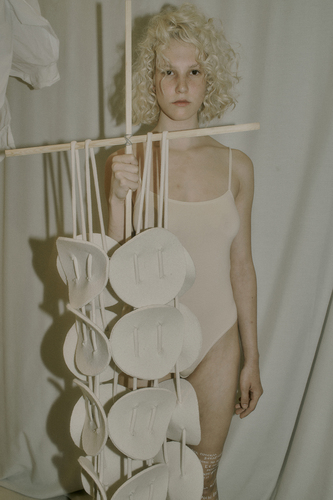
Images by WANG DAHOW at Berlin Fashion Week
In your “ANTICON” collection, color seems to symbolize life and transformation. How do you use the contrast between pure white and hidden colors to convey a sense of hope and personal growth?
In this metaphor, I’m not focusing on hope or personal growth, but rather on the discovery of our true personality, symbolized by the rainbow tapestry revealed when the white cotton trousers transform into a dress. This process represents the fulfilling sensation of homecoming, suggesting that the escapist mechanism of ‘inter-refuge’ might neutralize existential struggles.
Since “ANTICON” is dedicated to the ‘Utopia codes’ humanity generates in attempts to program happiness, I sarcastically comment on the fantasies of a pets’ afterlife while other animals are consumed as food. The iridescent gradient is decorated with button clusters mimicking paw prints, and a rope laces the silhouette in front of the audience, pointing to the distorted, stereotype-bound nature of modern human-animal interaction.
Throughout the collection, I explore colour through the lens of social stereotypes, ironizing the conformity of historical encoding systems. I pay tribute to the Itten colour wheel, the kabbalist Tree of Life, and the rainbow, which I decolorize by replacing pigments with abbreviations. This reflects my cultivation of initiation into secret knowledge, or gnosis, as I delve into spiritual paradigms within the “ANTICON” project.
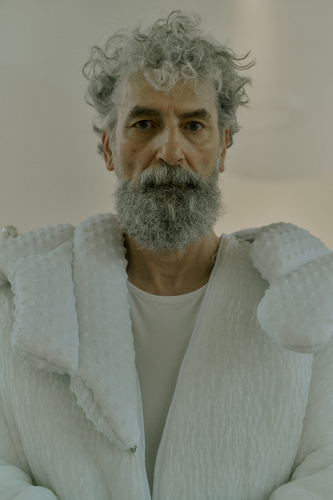
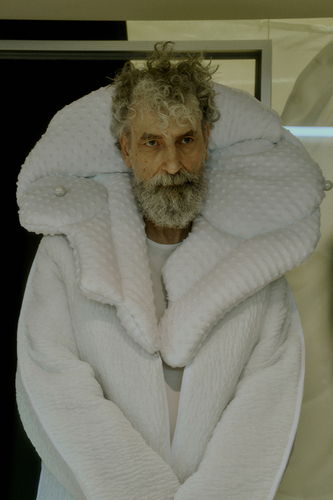
Images by WANG DAHOW at Berlin Fashion Week
How do you use the performance format to enhance the meaning of the collection, particularly in terms of the intersection of fashion and spirituality?
As I deciphered my trauma, I’ve traced the roots of my horrific frustration to the nourishing ground of expectations, imposed by the society and myself. The burden of personal values and duties is an eloquent focal point in the major religions. I’ve cultivated stoicism and self-sufficiency through the ‘object=subject’ speculation that inspired me to incorporate wearability into homeware objects.
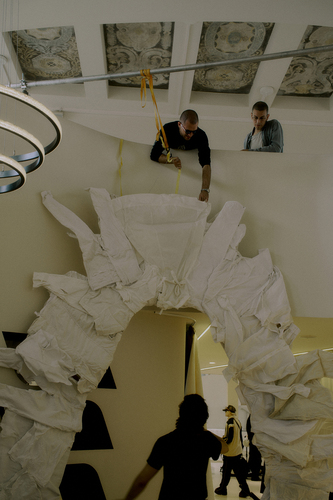
Thus, the “ANTICON” (‘anti-icon’) performance invites us to witness an avant-garde version of the Last Supper mystery with a grotesque finale, in which what looked like a served tablecloth, unexpectedly, serves as a lifesaving trampoline as the performers stretch it under my staggering figure and, eventually, takes a human-like shape, transgressing into an ethereal existence from whose hands I’ve read the ultimate verses of the act.
During the Berlin performance, you debuted as a poet. How does your poetry connect with your designs and enhance the overall experience of the performance?
I debuted as a poet at the age of 7-8 in a yard in Lozova, Kharkiv region, reciting my first rhymes in front of my Granny, a linguist and literature teacher who had home-schooled me from the age of 3, and her neighbours.
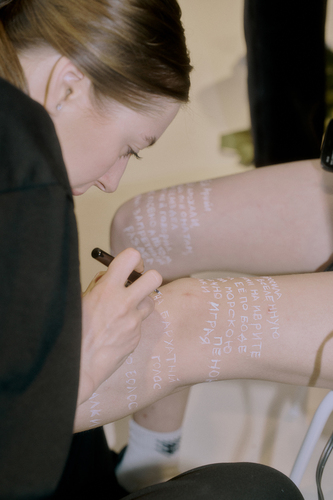
In Berlin, I’ve exploited the hype of the Fashion Week to release my first brochure of multilingual poetry on the international scale. Speaking seriously, the intimate poems, stylised in a quasi- spiritual manner, convey the mysterious nature of my personal relationship “ANTICON” is dedicated to. I read these poems from the models’ faces and bodies as their garments transformed, imbuing the metamorphosis with emotional depth and exposing the cathartic experience behind the designs.
What does the balance between functionality and symbolism in your designs say about the future of fashion?
I envision the fashion of tomorrow as a blend of ideological and utilitarian concerns, equally celebrating ethics and technology. Through my multipurpose outfits, made from cruelty-free materials for all identities, I aim to challenge stereotypes about ethical fashion being predictable and wearable art as impractical. Transformer clothing, powered by a strong concept, offers a smart way to transition to a sustainable wardrobe without limitations or repetition, enriching everyday self-styling with new possibilities.
What inspired the decision to stage the “ANTICON” performance as a meta-modernist reinterpretation of the Last Supper?
While processing my references, I instinctively mirrored the Byzantine Last Supper icon, projecting Orthodox halos onto the extended table. This led to a sensation of self-sufficiency within the composition, prompting me to correlate self-consumerism, a hallmark of modern humanity, with religious gastronomic customs. From this, I developed the grotesque ‘autophagia’ concept for a series of looks based on ritual table settings. The repetitive pattern modules in the outfits reflect this phenomenon: a shape coexists with its ‘counter-shape’ within a unified entity, interacting and co-nourishing.
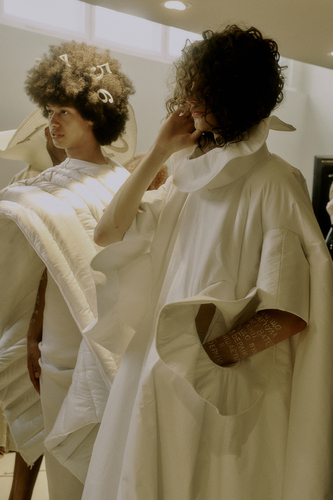
Images by WANG DAHOW at Berlin Fashion Week
How does your collection invite your audience to question or reinterpret their own ideas of identity and belonging?
In analyzing the correlation between the desire for self-discovery and the urge for homecoming, I questioned, “Can finding ‘where you belong’ replace the essential feeling of home?” I specifically reflected on gender identity, as a nonbinary person often frustrated by social stigmas and the pressure on atypical individuals. In solidarity with unique personalities, DZHUS celebrates a reunion with our true selves while challenging gender stereotypes. Through transformer clothing, I explore the fluidity of roles, fetishizing lingerie and corpcore. The ‘wrong’ side, colored in an iridescent gradient, ‘blesses’ wearers with life-affirming energy and suggests introspection as apath to fulfillment – our ‘portable home’. After the “ANTICON” performance and the “ABOLUTE” show, where I replaced music with a recorded monologue, I received positive feedback, with the audience encouraged to share their personal struggles. As an artist spreading a humanist message, this social impact was the greatest reward.
The semi-interactive nature of the performance invites the audience into the narrative. How do you think this interactivity influences their connection to your designs?
My entire creativity is missioned to evoke questions and reflections within the relevant existential narratives. Although the designs pay tribute to religion as the major concentration of social conformism, in the SS25 performance, I deliberately opt out of any artistic media other than abstract symbolism. Such solution involves a beholder into an intellectual quest, as their conscience begins to fill the context gaps with associations on the margin of the commonly accepted. Thus, the encoding process itself becomes interactive, pushing the boundaries way too far from a catwalk show routine.
DZHUS at Prague Fashion Week
 33 MAGAZINE