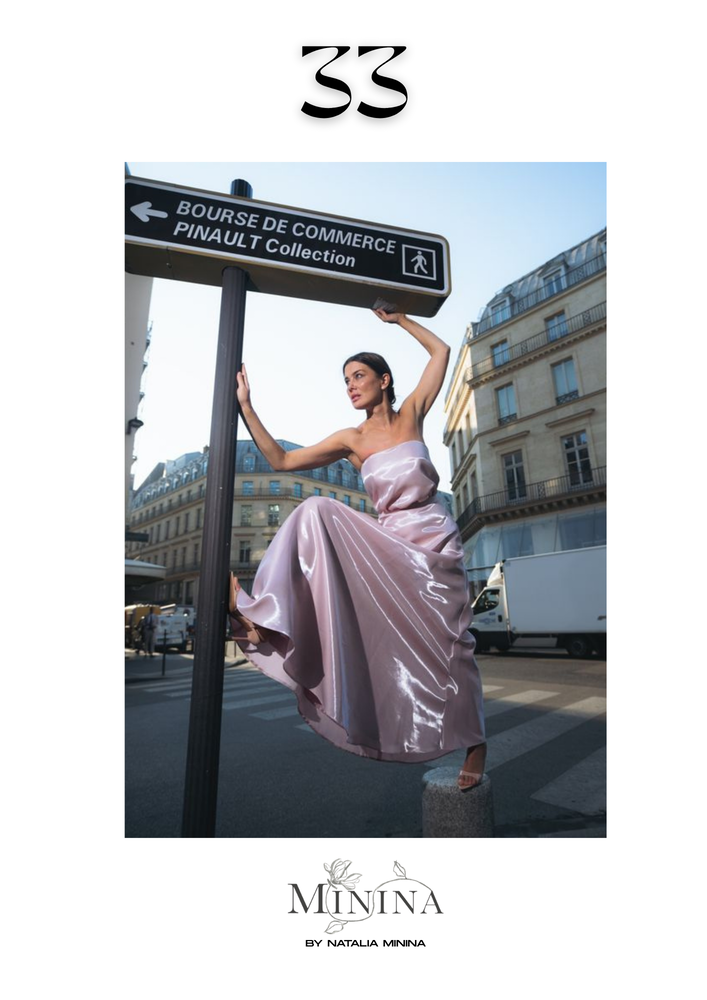
Natalia Minina + The Art of Making Fashion Personal through MININA STYLE
In an exclusive interview with 33 Magazine, fashion designer Natalia Minina reflects on the patience of couture, the beauty of thoughtful craftsmanship, and the importance of designing for women as they are.
Natalia Minina’s work asks us to look more closely. Her designs begin not with haste, but with the intimate process of making: choosing a fabric, imagining how it will fall against the body, and shaping it through hours of careful handwork. For Minina, a garment is never simply an object of fashion. It is the result of a considered relationship between designer, material and wearer. Founded in Minsk in 2019 as a haute couture atelier, the brand is built around that relationship. Minina remains personally involved at every stage of the creative process—from selecting and purchasing fabrics directly from factories to overseeing individual client orders. Each year, the atelier presents two collections: a dressy cruise collection crafted from natural linen, and a wedding and evening collection. Clients can also commission exclusive looks and capsule wardrobes, created with the person who will wear them in mind.
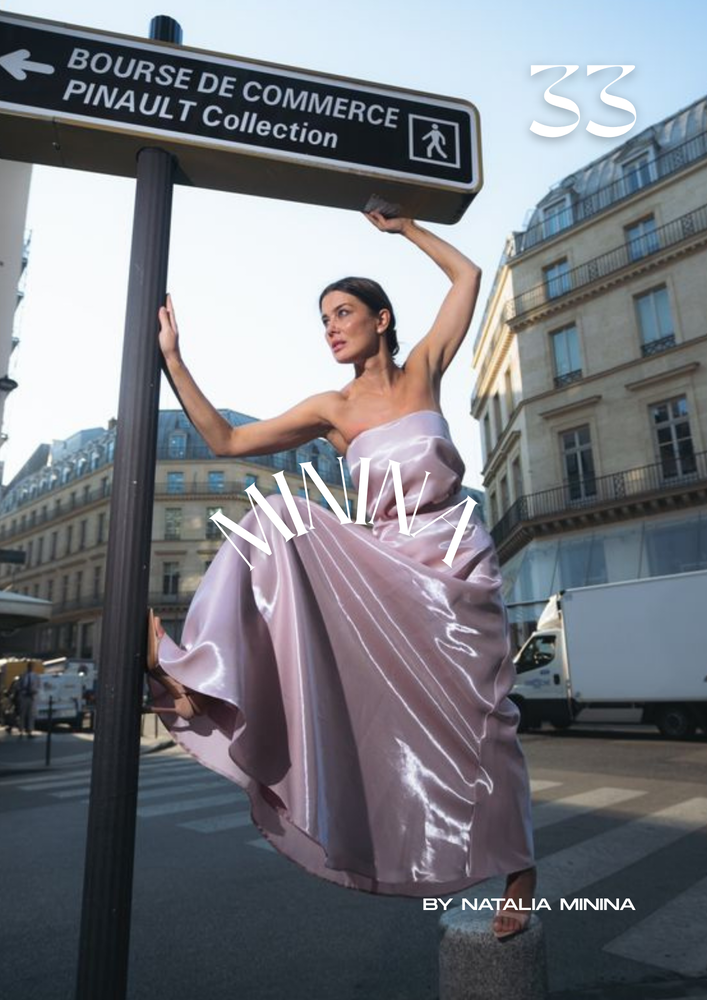
The result is fashion that feels personal rather than prescribed. Every choice—from the fabric’s texture to the way a silhouette moves—is guided by an attentiveness that places craftsmanship at the centre. That commitment has carried Minina’s work onto international stages. Her collections have been presented at official venues during Milan and Paris Fashion Weeks. In 2021, she became the first Belarusian designer invited to Milan Fashion Week; since then, she has shown at Paris Fashion Week six times and received an invitation to the opening of a showroom on the Champs-Élysées. Her work has also appeared in international publications including ELLE, Marie Claire, Madame Figaro and Fashion Magazine. But Minina’s vision extends beyond the garments themselves. She is proud to bring models with different body types to the catwalk, celebrating women’s natural beauty without imposing rigid boundaries on how it should look. Her participation in a show supporting the mission “Against Violence and for the Protection of Women’s Rights,” organised by the founders of the Seychelles’ first Fashion Week, reflects a broader belief in fashion’s capacity to make space for women’s voices and experiences.
In this exclusive conversation with 33 Magazine, Minina speaks about the patience behind couture, the decisions that shape a garment, and the importance of designing for women as they are—not as fashion expects them to be. It is an invitation to look beyond the collection and consider the person, practice and values behind it. Because when a piece is made with such care, its story deserves to be told with the same.
Threads of the Soul seems to function not only as a fashion collection but almost as a visual essay on grief, healing, and transformation. When did you first realize that this collection needed to become a narrative rather than simply a series of garments?
– « I realized this collection was a deep personal narrative at a moment of complete emotional shift. For over a month, I had been working on a series of sketches, but suddenly, I felt they no longer spoke to my current state. I never throw my sketches away, as I believe every idea can be re-evaluated and seen differently a year later. So, I archived those designs and set them aside, allowing pure instinct to take over.My creations have always existed outside of fleeting fashion trends — timelessness is the core foundation of my philosophy. But this time, the process became visceral. The new gowns were born exclusively at night. From my past experience, I knew that if I didn’t get out of bed to sketch them immediately, the vision would vanish by morning. These midnight sketches became a literal diary of my own healing and transformation written through fabric. »
The title itself suggests something intimate and intangible. Why did the idea of “threads” feel like the right metaphor for the emotional and artistic journey behind this collection?
– «For me, threads are the foundation of everything: fabric is woven from threads, and garments are stitched together by them. But “Threads of the Soul” is a deeper metaphor. I have a very fine, deeply sensitive soul, and it is connected by invisible threads to my work.This collection was not just manufactured; it was born through these emotional threads. It is the direct link between my inner sensitivity and the physical creation of the garments. »
Your work bridges historical heritage and contemporary romanticism. How do you approach the relationship between tradition and innovation so that neither becomes decorative, but both remain emotionally meaningful?
– «For me, tradition is deeply personal. My grandmother used to embroider large canvases using old Slavic techniques, and she taught me this sacred art. But I never copy the past directly. Instead of just using history as surface decoration, I preserve its core values: dedicated handwork, emotional depth, and high craftsmanship.I connect these heritage roots with modern construction to create designs that exist outside of fleeting trends. A gown carries the energy of generations and ancient handcraft, but its silhouette is light, clean, and perfectly suited for today. This is how I achieve a truly timeless aesthetic — by making pieces that are emotionally alive in the present, and will remain meaningful decades from now. »
Pieces like The Royal Milk Velvet and The Blue Chantilly feel almost symbolic, as if they carry emotional states within their construction. Do you design from image first, or do the emotions and materials develop together in the process?
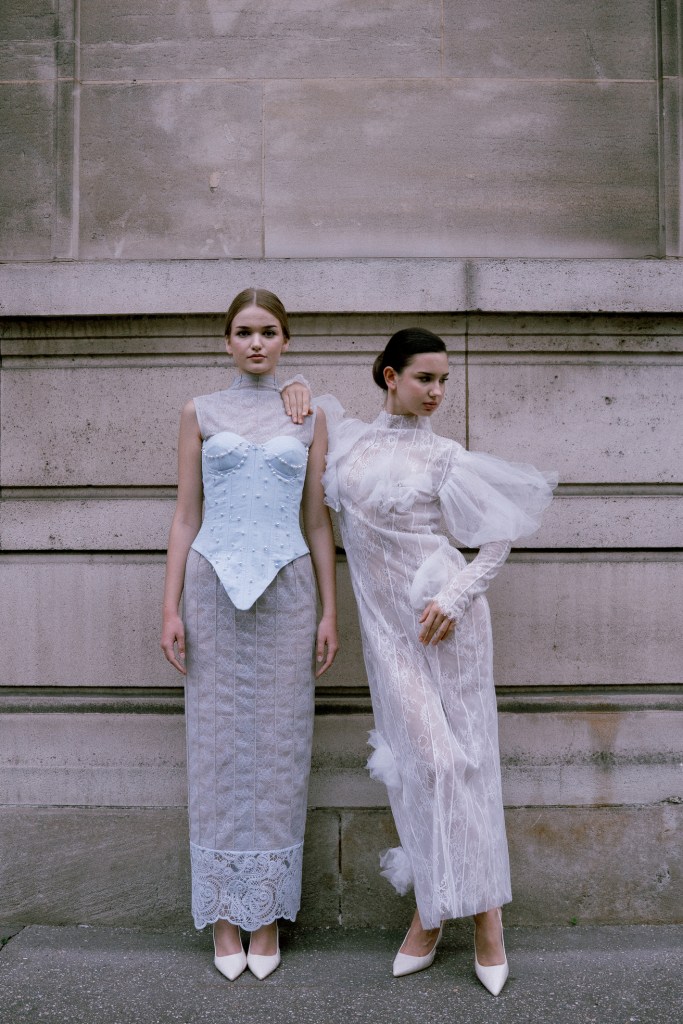
– « For me, the visual image and the material texture always develop together. Sometimes an idea rotates in my head, but it remains incomplete until I touch the right fabric. That is exactly what happened with these garments.The moment I saw this incredibly delicate, thin, sky-blue Chantilly lace, the entire design instantly crystallized in my mind. To support this fragility, I paired it with a structured corset and a basque made of milk-white velvet. Velvet is a texture I have wanted to work with for a long time. In this collection, it also inspired a completely separate piece: a long velvet gown with an elegant knot at the neck and a belt embroidered with handcrafted flowers. It is always a simultaneous birth of emotion, silhouette, and fabric. »
The introduction of black in this collection feels especially significant, almost like a punctuation mark in a language you have long spoken in softness. What did black allow you to express that color alone could not?
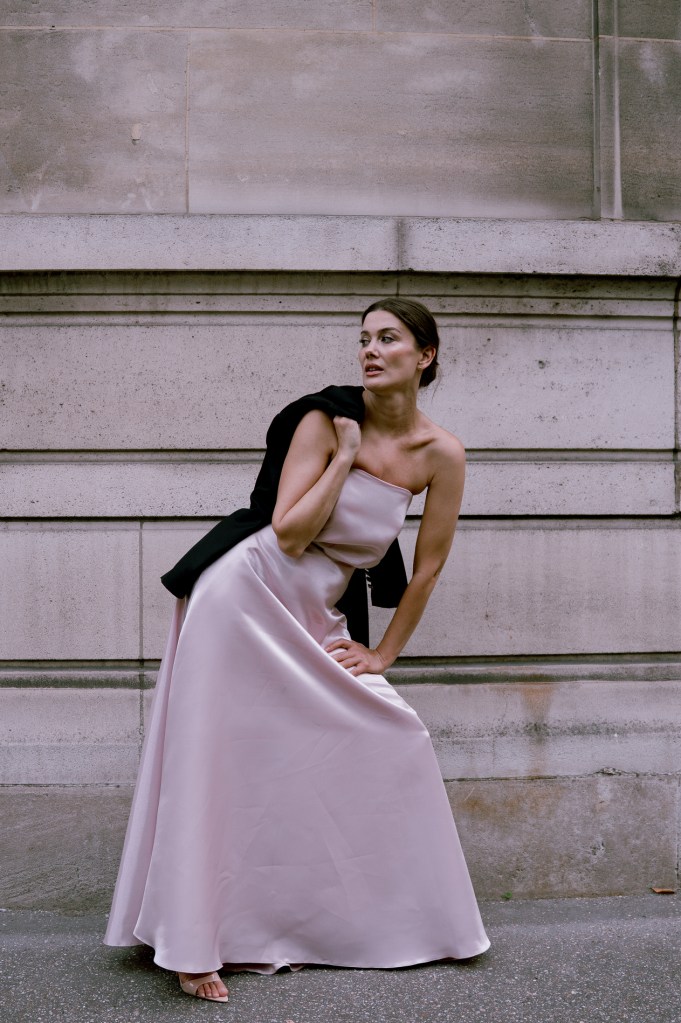
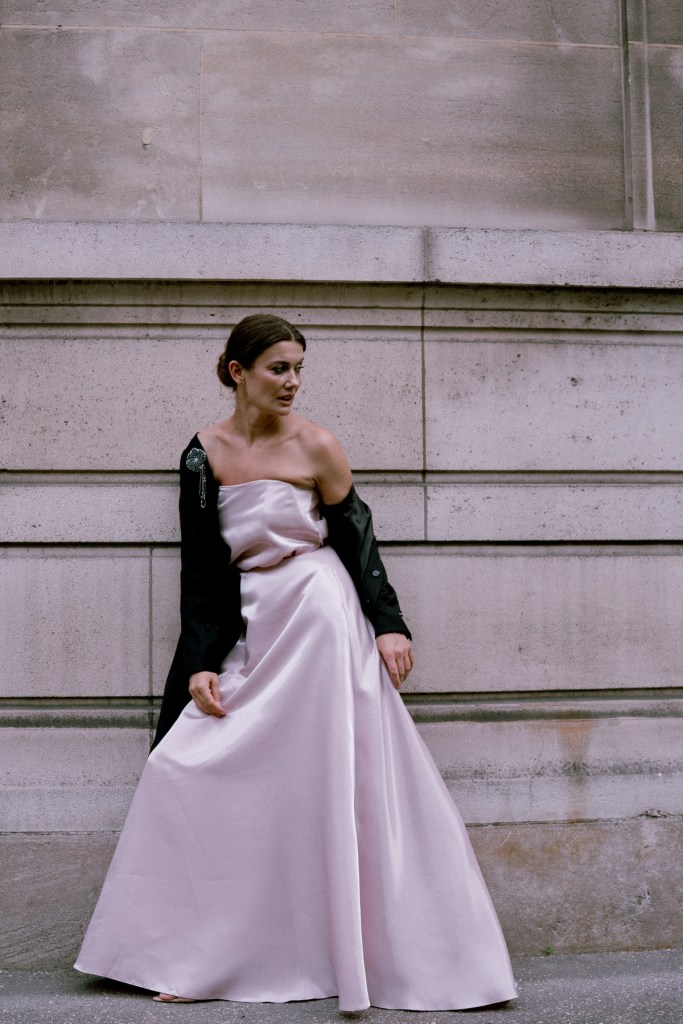
– « Black allowed me to express the true depth of my inner state at that turning point. Since this is an evening collection, black integrated naturally, but it functions primarily as a psychological and visual shield — a protective space to hide behind.My creative process is deeply intuitive and closely connected to the models who wear my art. Initially, I had a completely different vision for my main black satin gown. But the moment I saw the specific model during the casting, I realized that only a deep, profound black could truly reflect her presence and resonate with my emotions. Combined with the extravagance of a black cape, this color became a powerful punctuation mark: it added protection, graphic definition, and a dramatic evening mystery that light alone could never express. »
Your garments are highly crafted, yet they also carry a poetic stillness. How do you think couture can function as a form of artistic expression that goes beyond fashion trends and seasonal expectation?
– « For me, fashion at this level is first and foremost a pure form of art, not just a business of fleeting trends. It has the unique power to break boundaries because it does not answer to seasonal expectations.The poetic stillness in my work comes from this philosophy. When a garment is created with intricate techniques and dedicated handwork, the craftsmanship itself becomes a silent language. It accurately translates the designer’s internal narrative to the collectors and connoisseurs of art. If the execution is perfect and the message is authentic, a handcrafted garment ceases to be just clothing. It becomes a timeless artistic statement that will always be understood by those who appreciate true value. »
Follow MININA HERE
Website: https://natalia-minina.by/en/